

The GBO-A Scales
The GBO-A scales have been developed as a resource to use where the full GBO is not suitable for a client; this might be due to their age, developmental level, neurological issues, learning disability etc.
It has been adapted from the original version of GBO, with permission of the developer, Dr Duncan Law. It is designed to be a resource to help make working with goals and the GBO, even more accessible, particularly for people with additional cognitive and/or communication needs. The GBO-A offers a briefer scale (0 to 5) presented to be more visually accessible. It is not a replacement for the GBO.
Like the original GBO tool, the GBO-A is an aid to support better client centred practice, to facilitate discussions around client goals and goal setting. The GBO-A scales are designed to help measure progress towards goals using visual supports. It was developed by the Specialist Community Learning Disability Service in Sheffield, in collaboration with staff and a local learning disability self-advocacy group. Like the original GBO, the tool can be used with any clinical group that may benefit from a more visual presentation of information: younger children, older adults, people with an acquired brain injury etc.
GBO-A can be used to measure progress towards goals relating to direct and indirect interventions and can be rated by either the service user/patient/client or their family/carer as appropriate to the goal. Someone may have more than one goal, though we recommend no more than three. As with any scales, there will be people for whom the GBO-A is not suitable, for example due to their cognitive needs, their prior experiences or their preferences; clinical judgement and client preference should always guide the use of any tool.
GBO-A is a Patient Reported Outcome Measure (PROM). PROMs give agency to service users and can help to guide interventions ensuring they are meaningful to the person. However, GBO-A is not designed to replace clinician rated or experience measures. Best practice would be to incorporate all three types of measures for a holistic approach.
Caution: the GBO-A is a new adaptation of an existing scale, to be used and piloted as is clinically appropriate, across clinical and non-clinical settings. Although it is likely to have similar psychometric properties to the original GBO, these have not yet been tested, and caution needs to be used when interpreting the results from the GBO-A.
The Guidance and the GBO-A scales can be downloaded here
Using the GBO-A visual scale
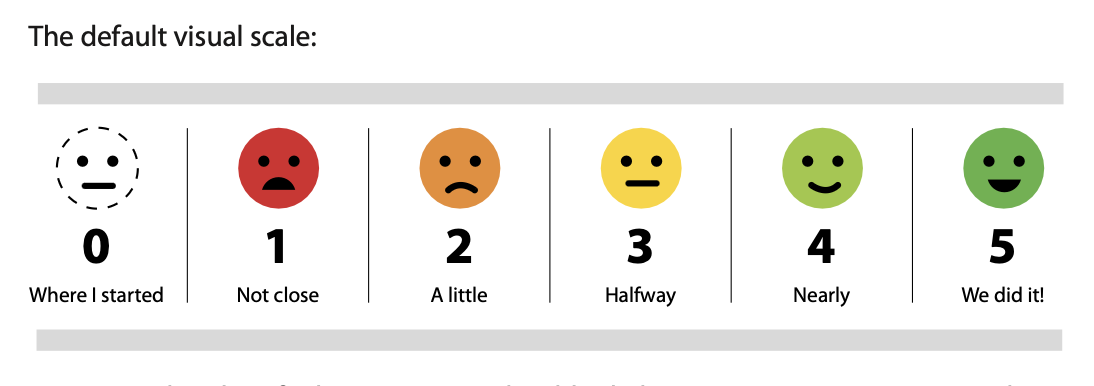
Once a goal is identified, practitioners should ask the service user/carer to rate where they currently are on the scale in relation to meeting their goal. Of note, not everyone will be at ‘Zero’ when they start the work in service. The goal can then be revisited and re-rated by the service user/carer at relevant points throughout the intervention, and always again at the end.
Scaling up the GBO-A to fit with the GBO rating scale
It is important to ensure that the scores recorded on any electronic record are scaled-up from the 0-5 scale of the GBO-A to fit with the 0-10 scale of the original GBO. This is to ensure that data from the GBO-A and GBO are comparable. This is particularly important for services within the United Kingdom where ratings from the GBO are aggregated at a service and national level.
The scaling-up of the GBO-A score is easily done by simply multiplying the client’s rating on the GBO-A by a factor of two. For example, if a client rates their goal progress as ‘zero’ you multiply this by two and the score remains zero: 0 x 2 = 0. If the client rates their progress as ‘four’, again, you multiply this by 2 and the GBO equivalent score is eight: 4 x 2 = 8. A GBO-A rating of ‘two’ becomes ‘four’ , a rating of ‘three’ becomes an equivalent GBO rating of ‘six’ and so on…